Medieval Canon Law by unknow
Author:unknow
Language: eng
Format: epub
ISBN: 9781000631494
Publisher: TaylorFrancis
Published: 2022-09-15T00:00:00+00:00
6 St. Bernard of Clairvaux, âDe consideratione ad Eugenium Papam,â 1.3.4â1.4.5, in Bernardâs Opera, eds. J. Leclercq, C. H. Talbot, and H. M. Rochais (Rome, 1957â1977), 3:397â399. For the translation, see J. D. Anderson and E. T. Kennan, Five Books on Consideration: Advice to the Pope (Kalamazoo, 1976), 29â30.
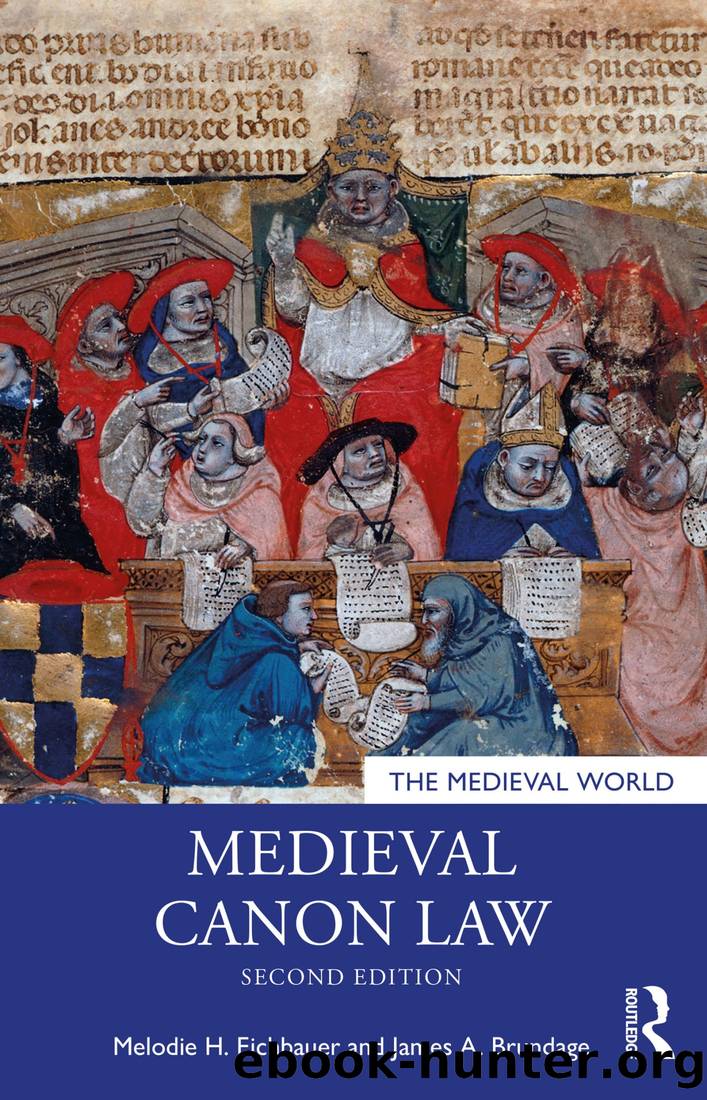
Despite entreaties such as these, late-twelfth-century popes continued to contend with a rising tide of litigation. They secured a measure of relief by appointing ever-greater numbers of men with legal training to the College of Cardinals and relying increasingly upon the advice of the cardinals who assisted them in hearing cases in what came to be called the Roman consistory. The consistory replaced the old synod of the Roman clergy, which under Gregory VII (d. 1085) had become primarily a court of justice. In the new judicial structure, the pope met daily with the cardinals and other advisers. There the whole group heard arguments and appeals, which the pope then decided in consultation with the cardinals. The consistory was thus a judicial body in which the cardinals sifted through the arguments and issues that litigants raised and advised the pope about his options in disposing of the matter before them. This arrangement shifted the burden of the preliminary analysis of disputes from the pope to the cardinals, but still left the final determination of each case in the popeâs hands. Although the consistory eased the burden of the popeâs personal involvement in the judicial processes, it still required a massive commitment of papal time. Other papal businessâpolitical, diplomatic, financial, and religiousâurgently demanded attention.
Judicial offices developed during the thirteenth and fourteenth centuries to distribute the papacyâs workload. The Audientia litterarum contradictarum screened the issuance of papal mandates and regulated the activities of the proctors who represented clients and managed their business at the curia.7 The Referendarii signaturae evolved from a group of clerks in the papal consistory who prepared documents for the popeâs signature to one that drafted replies to petitions and determined which appellate cases were sufficiently important or meritorious to warrant the popeâs personal attention. By the late Middle Ages, it would morph into the Signatura iustitiae, the highest-ranking papal appellate court.8 The popeâs chief fiscal officer, the chamberlain (camerarius) who oversaw the financial office of the camera, appointed a hearing officer (auditor) to adjudicate disputes that arose out of financial operations and eventually to deal also with disciplinary problems among members of the papal curia.9
Download
This site does not store any files on its server. We only index and link to content provided by other sites. Please contact the content providers to delete copyright contents if any and email us, we'll remove relevant links or contents immediately.
The Vikings: Conquering England, France, and Ireland by Wernick Robert(84374)
Ali Pasha, Lion of Ioannina by Eugenia Russell & Eugenia Russell(40314)
The Conquerors (The Winning of America Series Book 3) by Eckert Allan W(37892)
The Vikings: Discoverers of a New World by Wernick Robert(37005)
Cecilia; Or, Memoirs of an Heiress — Volume 1 by Fanny Burney(32635)
Cecilia; Or, Memoirs of an Heiress — Volume 2 by Fanny Burney(32009)
Cecilia; Or, Memoirs of an Heiress — Volume 3 by Fanny Burney(31996)
Empire of the Sikhs by Patwant Singh(23135)
The Secret History by Donna Tartt(19288)
Hans Sturm: A Soldier's Odyssey on the Eastern Front by Gordon Williamson(18648)
Cat's cradle by Kurt Vonnegut(15438)
Pimp by Iceberg Slim(14659)
Sapiens: A Brief History of Humankind by Yuval Noah Harari(14458)
Norse Mythology by Gaiman Neil(13456)
Talking to Strangers by Malcolm Gladwell(13438)
Leonardo da Vinci by Walter Isaacson(13407)
4 3 2 1: A Novel by Paul Auster(12504)
Underground: A Human History of the Worlds Beneath Our Feet by Will Hunt(12143)
The Radium Girls by Kate Moore(12089)
